
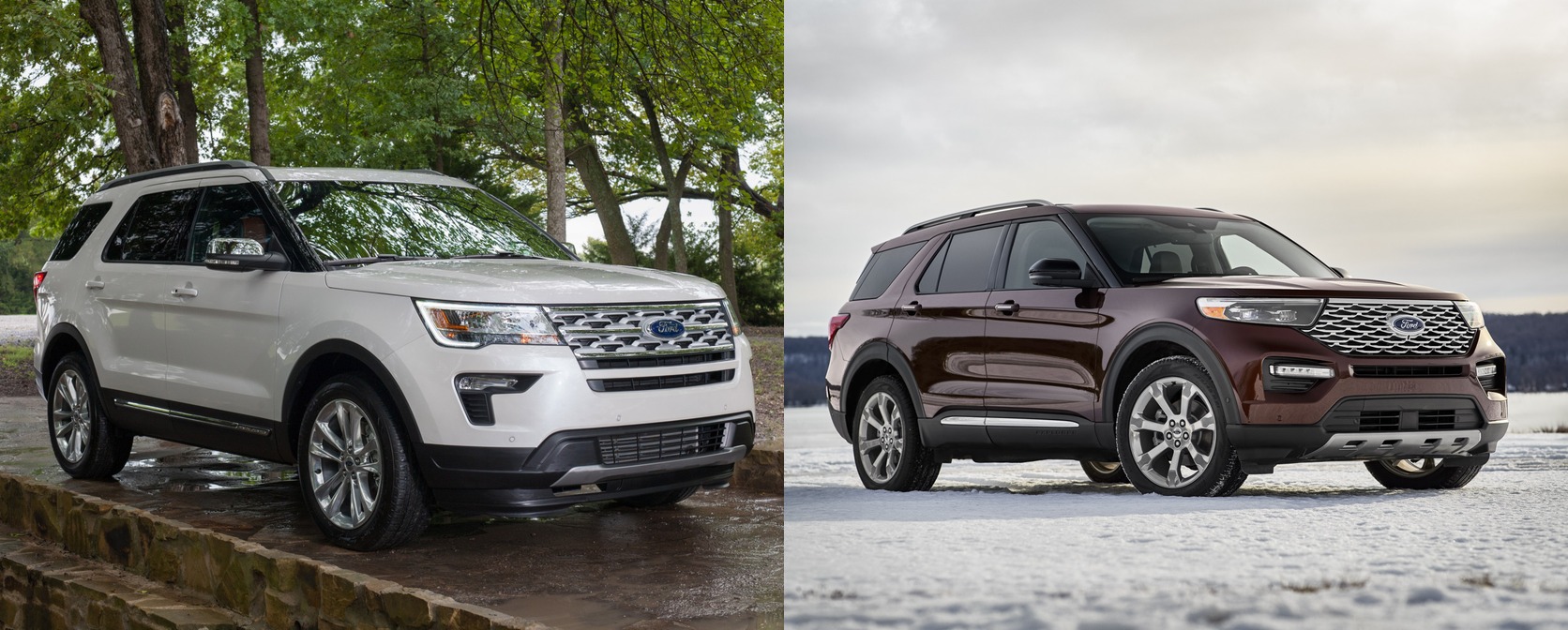
Quick Read
- The 2019 Ford Explorer earns an A (96/100) on the CarDependability Index (CDi), while the redesigned 2020 earns a D- (63/100).
- Over each model’s lifetime, owners of the 2020 Explorer have filed complaints at more than four times the rate of 2019 owners; transmission and drivetrain issues make up 40% of these reports.
- The 2020 Explorer has 35 recalls versus six for the 2019 Explorer.
The Ford Explorer helped launch America’s love of SUVs in the early 1990s. Ford bills it as America’s all-time best-selling SUV, which translates into an ample supply on the used car market. For shoppers looking to save money on a second-hand Explorer, the 2019 and 2020 model years look like good bets, but a closer look at reliability data shows a sharp contrast between them.
The gap comes from the CarDependability Index (CDi), which looks at owner complaints submitted to the National Highway Traffic Safety Administration (NHTSA). Each model year is then ranked for its first few years (Early CDi) and then over its life (Long-Term CDi). You can read more on our How the CDi Works page.
2019 vs. 2020 Ford Explorer: model year changes
2019 marked the last year of the fifth-generation Explorer. This platform, which debuted for the 2011 model year, featured front-wheel drive (FWD) with optional all-wheel drive (AWD). Engine choices included a 3.5-liter V6 (290 hp), a turbocharged 2.3-liter four-cylinder (280 hp), and a twin-turbo 3.5-liter V6 (365 hp). A six-speed automatic transmission managed power distribution.
Ford introduced an all-new sixth-generation Explorer for 2020. The architecture shifted to rear-wheel drive (with AWD optional), and Ford made several under-the-hood changes. Power on the base turbo 2.3-liter engine increased to 300 hp, while a new twin-turbo 3.0-liter V6 makes 365 hp in the Platinum trim and 400 hp in the performance-focused ST grade. A 3.3-liter hybrid V6 was also available. All powertrains have a ten-speed automatic transmission. Extensive changes often come with early production issues, as highlighted in Car Refresh vs. Redesign: Why It Matters When Buying Used.
2019 Ford Explorer: the safer bet
The 2019 Ford Explorer isn’t perfect. No car is. But it benefits from years of Ford sorting out the kinks that appeared early in the fifth generation. Its 95.8 Early CDi score, an A grade, is among the best for all Explorers within the past two decades. The Long-Term CDi, 1.39 complaints per 1,000 vehicles, puts the 2019 Explorer in average territory, which is respectable compared with other Explorer model years. About 52% of owner complaints involved body and exterior issues. While these problems aren’t insignificant, they’re less impactful on reliability than transmission and drivetrain problems, which are much further down the complaint list and account for 12% of reports. The 2019 edition has six recalls.
But what about the water pump? It’s a legitimate concern with V6-equipped 2011-2019 Explorers. The engine design uses an internal, chain-driven water pump that’s prone to failure and is expensive to repair. Ideally, find one with a documented service history showing the pump has been replaced.
2020 Ford Explorer: a rough debut
A D- may be a passing grade, but an Early CDi of 62.6 is nothing to brag about. A Long-Term CDi of 6.03 complaints per 1,000 vehicles reinforces that grade. It lands well below average: 93% of 2020 model-year vehicles had a lower lifetime complaint rate. What’s especially troubling is that transmission and drivetrain issues account for about 40% of owner complaints, followed by driver assistance (16%) and electrical problems (15%).
Yet it gets worse: with 35 safety campaigns, the 2020 Ford Explorer is the second most recalled vehicle in the index, behind only the 2020 Mercedes-Benz GLE. Admittedly, recalls aren’t automatically tied to dependability, but almost three dozen campaigns suggest this SUV has had numerous underlying issues from day one. A comparison between the 2017 and 2018 Toyota Camry also shows what can happen with the first year of a new generation.
2019 vs. 2020 Ford Explorer: the value play
As is usually the case when shopping for a used car, newer models come with a higher price tag. CarGurus shows the 2019 Explorer has an average asking price of $17,700, while the 2020 edition rises to about $23,000. For an extra $5,300, or 30%, you get a newer design, more horsepower, and a hybrid option. However, these bonuses may not be worth it given the 2020 Explorer’s higher complaint and recall rate. The concentration of transmission and drivetrain issues is another concern. The 2019 Explorer makes a much stronger case.
What used Ford Explorer shoppers should know
The CarDependability Index is a good starting point, but thorough used car research should include:
- Check Open Recalls. Enter the vehicle identification number (VIN) or license plate number into NHTSA’s recall lookup. Both model years have a recall history, but this step is especially crucial for the 2020 Explorer and its 35 safety campaigns.
- Get a Vehicle History Report. A background search can reveal accident damage, title problems, unusual ownership activity, and other details.
- Take an Extended Test Drive. Spend at least 20-30 minutes behind the wheel in different driving scenarios. Pay close attention to how the transmission shifts at low speeds and under acceleration.
- Schedule a Pre-Purchase Inspection. After you’ve completed your DIY used car inspection, hire an independent mechanic to perform a more detailed exam.
If you prefer the sixth-generation Explorer with better ratings than the 2020 edition, compare later model years in the CarDependability Index (CDi) before you buy.